| ||||

| Home Page Agency Information Planning Program Construction Program Agency Publications |
STATE OF WYOMING
|
|||

| LINK TO ALL INSTREAM FLOW FILING SEGMENTS: | |
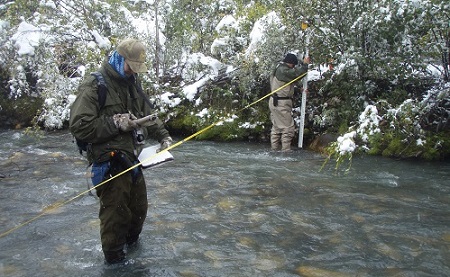 Spring stream flow measurements |
| DEFINITION & LAW OF INSTREAM FLOW: |
|---|
| Wyoming water law dates back to territorial (pre-statehood) days and is based on the "doctrine of prior appropriation". Under this doctrine the first to put the water to beneficial use has the first right, or "first in time is first in right". This means the earliest (senior) rights are entitled to water during periods of limited supply, while those with later (junior) rights are denied water during these times. Prior to 1986, Wyoming water law required water to be diverted from its natural state and conveyed to a point of use to constitute beneficial use. In 1986, enactment of the Instream Flow law expanded this concept to allow the State of Wyoming to hold a water right for instream (water that flows in a natural stream channel) fisheries purposes. Thus, a new water right can be issued to allow water, when available, to remain in the stream channel and be protected for fisheries purposes according to its water right priority. This 1986 law recognizes instream flow for fisheries as a beneficial use. This beneficial use did not change Wyoming's longstanding, traditional water law system. Instream flow designation was important because it meant for the first time in the State's history, water could be protected in streams for fish. Instream flows benefit the 41% of Wyoming residents who fish annually. They also profit the State's thriving tourist industry that's based in large measure on flowing streams for enhanced angling, boating, sight-seeing, hiking, backpacking, and camping. |
CLICK HERE To access the latest Instream Flow segments summary (23 Oct 2023)
Active Instream Flow hydrologic studies
- Upper Wind River Instream Flows 2019
| For additional Instream Flow Filing information contact Chace Tavelli Project Manager |
| INSTREAM FLOW FILING PARTNERSHIP | ||||
 |
 |
 |
||